Friday, November 19, 2010

Sichuan Vacation

My apologies for the delay on this post...after I got back from the Sichuan Province I realized how little time I have left here and decided it was time to get off blogging and get lost in the city. My friend Liz from Georgetown has just arrived after her study abroad program ended in Australia, so there's going to be a lot of that for the next couple of weeks - starting with Huangshan (Yellow Mountain), which we head to tomorrow. During the National Holiday I had plans to go, but there were too many places we planned to get to in a single week, so I saved it until now.

But until then, a quick recap of my the weeklong with the school from October 29 to November 7.

We first headed to the Three Gorges, where we had a three day boat cruise with various stops. The first place we visited was the newly constructed dam that all the Chinese are very proud of but which stirred a bit of controversy when it was built 10 years ago. The government had to force many of the people living around the river to leave because of the resulting rise in the water level. We had the opportunity to stay in a (rather rural) homestay before getting on the boat and were able to ask the families how they felt about the dam, and it seems that although they aren't thrilled, they at least understand the importance of the dam has to prevent the numerous floods that used to happen every year.

Amongst our off-boat tours, we went to the City of Devils (where families send off the spirits of their loved ones to be "judged" by the Kings/gods etc. who do that kind of thing). My favorite tour was when we took a traditional paddle boat through the narrow valleys of the gorges. We even got to see "hanging coffins" that are embedded in the mountain rock - how they got up there still remains a mystery, especially considering the water was 100 meters lower back in the day.

We headed to the Tibetan region of Jiuzhai Gou, where we saw multilevel waterfalls, turquoise waters, underwater forests, and the most beautiful snow-capped mountains. I wish a picture could capture the beauty, but this will have to do...

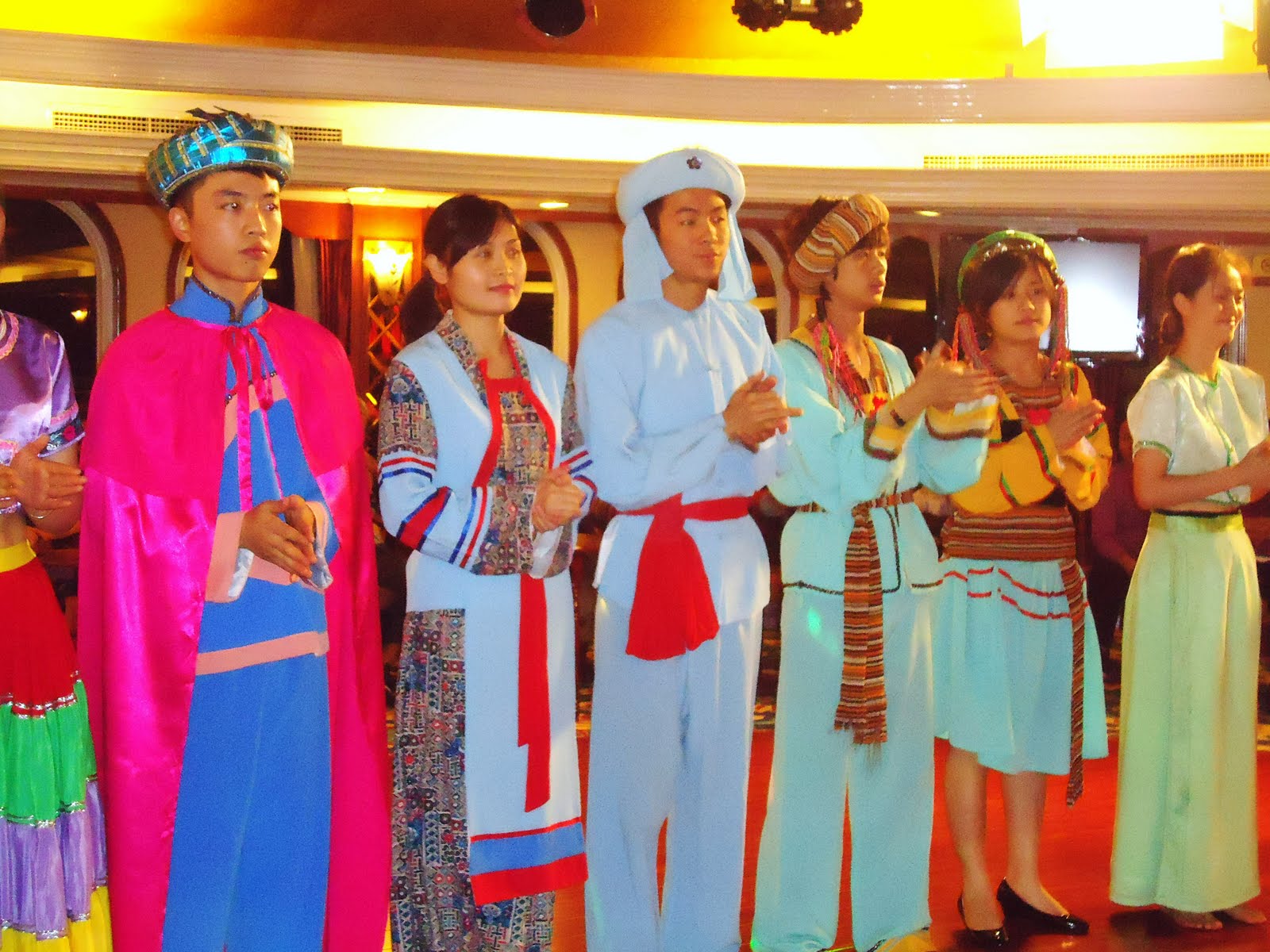
At night, we had dinner with a Tibetan family (...it was aimed at Chinese tourists, but we'll pretend it was a real family). They performed traditional Tibetan songs - that's when I joined them for a dance.

Prayer Tablets - Tibetan village (above), dinner (below)
The next day we climbed HuangLong (Yellow Dragon)Mountain -- it took forever and some people suffered from the high altitude, but it was definitely worth the view from the top (notice the Tibetan temple in the back).

After eating the traditional spicy hot-pot, we saw the long-awaited for Pandas before returning back to Shanghai. We all loved the good outdoors, but we very happy to return to the city.


One of my favorites...

Sunday, November 7, 2010

Holistic Thinking to Breed Understanding

I just returned from my 10 day break in the Sichuan Province exploring the Three Gorges, JiuZhai Gou "miracle" national park, and climbing HuangLong (Yellow Dragon) mountain - so as I catch up on things due tomorrow, I'll share this until I have time to post further updates...

While abroad, I'm participating in Georgetown's Berkley Center for Religion, Peace and World Affairs' Junior Year Abroad Network (JYAN). JYAN aims to connect Georgetown students studying abroad in a variety of cultures, giving them an opportunity to share their reflections on religion, politics, and society.

You can see my original letter here - I urge you to check out the website and see what other letters my colleagues have written while abroad as their experiences and reflections are amazing and eye-opening.But for convenience, here is my letter reproduced below with added photos...

"Once Zhuang Zhou dreamed he was a butterfly. A butterfly fluttering happily around--was he revealing what he himself meant to be? He knew nothing of Zhou. All at once awakening, there suddenly he was--Zhou. But he didn't know if he was Zhou having dreamed he was a butterfly or a butterfly dreaming he was Zhou. Between Zhou and the butterfly there must surely be some distinction?"

This is the “way” of the Dao 道 (romanized as Tao), one philosophy that governs Chinese religious values, which is better described as Chinese spirituality. When I first arrived in Shanghai, I saw neither churches nor temples lining the traffic-ridden streets, did not see my host family partake in any weekly rituals, and didn’t even hear the topic of religion arise in any conversations. I naturally wondered, does this society have a religion?
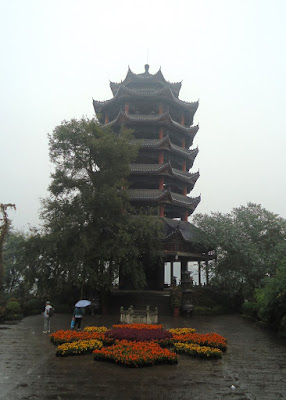
Various styles according to dynasty

Chinese religion has no leadership, no headquarters, no founder, and no denominations. But just because you do not seen mangers displayed during the holidays or engage in heated religious discussions does not mean that the Chinese are not spiritual. Rather than a unified system of beliefs and practices, Chinese religion is a complex interaction of philosophical traditions. The three most influential are Buddhism, Daoism, and Confucianism.
"100 Sons Buddhist Temple" - where a woman prays for children (males, of course) Location: City of Devils

Surrounding Buddhism is the idea that nothing is permanent; there is no self or soul. Human existence instead is a combination of five impermanent stages, making the idea of impermanence less frightening than it is in the West (take our views of death, for instance). Contrasting the Western view of a static, linear world, the Chinese believe that the world is composed of cyclical ups and downs: “In the midst of that brief moment of happiness never forget that ‘even the best party must have an end.’” In times of good fortune, they begin to prepare for bad ones--no wonder the Chinese are known for working hard but never spending a dime!

The cycles in Buddhism compliment the Yin and Yang belief of Daosim. Daoism focuses on non-action and non-intention to return to th e state of purity in which we are born. Through this non-action, one can establish a harmonious and orderly world. Spiritual harmony taught in Daoism complements the Confucian emphasis on duty. Confucianism draws away from the self and focuses on one’s relationship with others, teac hing people to be satisfied with their social position, which helps minimize conflict resulting from disrespect and disagreement. You can see the contrast to the Western emphasis on analyzing the person in isolation from his environment; isolating pain from the rest of the body, distinguishing my human rights from yours.

Statue in Daoist Temple (left) - Compare with the one of the gods of the Underworld (right)

The holistic thinking that guides these “religions” also guides Chinese society. In my Cultural Currencies class, we often examine the differences between Chinese and American culture. Reflecting on where our cultural beliefs come from helps make sense of our differences. For instance, the Chinese focus on communal and family relationships rather than individual achievements, describing objects in relation to other objects is more common than classifying them based on descriptive differences. In the West, the story of Genesis is ingrained in our society; whether or not you are religious, you are at least vaguely familiar with the story. The story of Adam and Eve demonstrates how Westerners are taught to focus on abstract attributes of object, person, place and separate them from other objects (you are man, I am woman; these trees are good, this tree is bad). The West focuses on individuality while the East focuses on connectivity or holism. In a survey asking Easterners and Westerns what two are best related out of the cow, dog, and grass, the majority of Westerners chose the cow and dog because they can both be “categorized” as animals, while Easterners said cow and grass, giving greater attentio how the objects are related: cows eat grass.

The Chinese perception of the world as a complex, constantly changing and interrelated place starkly contrasts the Western view of the world as a simple, fundamentally unchanging collection of discrete objects that is easy to understand if we use scientific laws and logic. You can see these differences in law, medicine, human rights, and religion.

Lighting Incense preparing to bow three times to Buddha. Location: Jing'An Buddha Temple

At first glance, the Chinese law system seems absurd to Westerners. Problems are most easily resolved through the community. Rather than distinguishing between “right” and “wrong,” they seek the Daoist “Middle Way,” avoiding hostility and debate in search of compromise. My Cultural Currencies professor shared a personal story from when her neighbor’s dog ran into her apartment and ruined her carpet. Outraged, she began arguing with her neighbor and requesting he pay for the damage. The other neighbors soon came out to add their input, which were actually a group of women specifically organized to resolve community issues like these (as opposed to taking it to the People’s Court). In the west, there would be a clear winner and loser in this situation, resulting in my teacher either having to pay for a new carpet herself or the neighbor bearing the cost (that is, if we assume the two involved parties didn’t mind the neighbors “muddling in their personal affairs,” an idea quite foreign to the Chinese). In China however, this group decided the neighbor would give my professor about half the cost of the carpet. As a Westerner, you may see this as an unfair solution where both parties are “losers” but in China both are “winners.” In a society that avoids conflict, Judge Judy would never cut it.

Eastern medicine also takes a holistic approach to curing pain and diseases. Herbal remedies target connected areas of the body that will indirectly cure the problem area--take reflexology for example. By targeting various trigger points in your feet, you can cure neck and back pains.

Confucian Temple
This non-interventionist approach contrasts the Western approach to tackle the problem where you see it; surgery rather than herbal remedies are the standard solution. Although the Chinese have seen the introduction of Western methods within their culture, most still believe that altering one part of the body through surgery is crazy because of the abundance of negative repercussions it has on other parts of the body. After all, everything is connected.

The United Nations often scrutinizes China for its violation of the Universal Declaration of Human Rights, urging China to alter its ways. But this issue is more complicated than creating more effective laws when it extends deep into their culture of holistic thinking. In the west, all individuals are separate and given certain rights. In the east, the individual is part of a whole and consequently gets a “share” of the total rights.

With lackadaisical human rights policies, I would assume religious persecution would be a problem. Yet in a society that seeks holism a
nd harmony, they take a “both/and” approach rather than and “either/or” approach. Western history is plagued with religious wars provoked by beliefs that either one religion or the other is supreme. China, however, is a nation of tolerance and interpenetration of religious ideas that goes hand-in-hand with the three schools of thought or spiritual philosophies that guide the nation.

In a society that avoids debate, conflict, and cate
gorization, it’s no wonder that you often cannot distinguish between these three philosophies. You will rarely find one of these “religions” practiced in isolation of another, nor do people make it a point to ask you what you practice. Coming from a society that often finds itself in debates over the separation of church and state, I find this harmony refreshing. Perhaps the Chinese can be a leading example for religious tolerance. When you believe everything and everyone is connected and place a high value on relationships with others, preserving those relationships facilitates resolving conflict.

Good News: The trip resupplied my stock of bad translations...

Sunday, October 24, 2010

Is it really just foreign curiosity?


This weekend consisted of dinner with the host grandparents for my host brother's birthday (side note: birthdays are not a big deal here. I didn't even know it was his birthday until he came home from a day of studying, and he didn't even stick around very long for dinner despite it being for him - all of this followed by cake minus the song. The end.), a trip with my host mom to a former government official's garden/home (in China, they can almost be synonymous), and a night listening to live Latin jazz music - Spanish mixed with some Caribbean bongos in the middle of China sounded like a good night to me.

But it doesn't quite sound like the weekend before midterms...

Views from the garden

Black swans

Some really large lilly pads

Not to worry. I promise I'm still learning. I'm taking a class on Modern Chinese History that I find really interesting both because my professor is an amusing Chinese man with a fabulous English accent who often comments on where China went wrong. It's great because he'll tell us what the Chinese think about history and then put in his two-sense ("the Chinese really messed up with the Boxer Rebellion, and hell, they still blame the foreigners!")
Looking at the history of the Opium War has given me a lot of insight into why China has had difficulty modernizing. Here's an excerpt from a response paper I wrote for class...

"Ever since China’s initial contact with the West, China has been skeptical toward the West. Western presence threatened what China viewed as their superior culture, one that could gain little from what they viewed as foreign, 'barbaric' nations. Beginning with Lord Macartney’s Amherst mission to expand trading privileges with China, Westerners disrespected Chinese culture (note: Burning of the Summer Palace as one example) and challenged its 'moral superiority.' During the 19th century, foreign success in the treaty ports revealed the weakness of China’s political system, destabilizing Chinese society and causing citizens to reevaluate their nation’s identity. Humiliated by foreign domination, a new nationalism emerged determined to undermine the success of coastal ports by separating them from the 'authentic,' peasant cities of interior China."


When we talked more about this in class a while later, my professor provided a personal story from just a couple of weeks ago. A fellow Chinese guy approached him on the train and their convo went something like this:


Guy: What are you reading? (intrigued that it wasn't in Chinese)

Professor: Chinese History

Guy: But it's in English.

Professor: Yes?

Guy: Written by foreigners.

Professor: Yes.

Guy: How can you read that!? How can you trust what they say?

Professor: He's a distinguished historian. He went to school, got a degree...

Guy: Do you mean to say that someone not from their native country can really write another country's history? Absurd.

Professor (to the class now): Luckily, he had a ticket for a different car and was kicked out just in time or God help me if I was stuck with him for 3 hours...

And later noted: But even after he was gone some people in the car said 'He had reason though, no?' I'm telling you, people really do think this way.


There's still strong animosity toward foreigners, creating this us vs. them phenomenon.

Which is why when people stare at me while I'm walking down the street, I have to wonder if it really is pure curiosity like my host family says, or if it's resentment. To become modern is to Westernize, to so-called "Westernize" is to reject the real Chinese values. Why can't they coexist? Why can't you adopt modern ways and merge them with traditional values?


.

Sunday, October 17, 2010

The Perfect Day...in Europe

One thing that distinguishes Shanghai from any other city in China is that you can walk out of your apartment and venture to Europe for the day.

Shanghai’s position as a former treaty port meant it modernized while the rest of China was still struggling with the feudal system of landowner vs. peasant. Foreigners and Chinese lived side-by-side (despite the exaggeration of some history books that foreign concess
ions were off-limits to the Chinese), introducing Shanghai to a new lifestyle, new mannerisms, and different goods. Today you can walk around the French Concession and see it as either a bitter memory of Shanghai as a foreign stronghold or as a neighborhood that has become a part of Shanghai’s unique culture.

Today it was a blessing.


Ever since returning from vacation over the Golden Week, I realized how much Shanghai has to
offer and how I better start to take advantage of it seeing that time is already flying by. Yana and I have been on a mission to explore all the great cafés, finding it to be a great compromise between exploring the city and still getting work done (studying Chinese takes away the whole studying abroad and not doing any work thing). The location of our school/home in Shanghai is the real deal – that means we experience the crazy traffic, walk around the not-so-clean streets, and battle with the random “Hello girl!” yells we get because we’re foreigners. So taking a break for a couple hours on the weekends to explore an entirely different side of China is quite enjoyable. We’ve made it to five cafés over the past two weekends and are still on a mission to explore them all before the end of December.

But today’s combination was particularly perfect.

My day started by venturing out to the farmer’s market with two friends I met for the first time going out to salsa on Friday. Yes, salsa. Like I said, Shanghai is a bit different than other Chinese cities. Sure the once-a-month farmer’s market was tiny and naturally filled with foreigners, but it was cool to find the comfort of what I love at home in a country that completely contrasts my own.

You can hold hands under your glove - a farmer's market find

I stopped home to drop off my splurge-purchases to find my host mom excited as ever to tell me she found what I’ve been looking for with a flyer in hand to prove it: a gym/dance class studio around the corner for 200kuai/month ($30). This might sound like a small gain, but after running around random apartment building parking lots (fail), attempting to walk around the school’s field amidst mini-soccer games conveniently located on the track (fail), and trying to do yoga on a hardwood floor (fail), this was great news. Plus, my host mom has been so responsive and gets soo excited when she comes home with something looking-like I mentioned that this moment just adds to how nice she is…she’s certainly in the running against my host dad for most amusing person in my household. I will continue to recommend staying with a host family for the comfort of having a group of people who genuinely cares.
Little Italy --- Little France
(both surrounded by wine - now you know you're "not" in Shanghai)

After this bonding-moment, it was time for some café therapy. The café we ventured to today was in the historic district of Shanghai, reppin an Indi-hip, kind of Spanish theme. After, we traveled to Italy for pizza that came close to Pizza Paradiso/Paolo’s mixed with Chinese waiters – a long-awaited craving, and stopped in France at a bakery before making it home. Sure we spent way too much time chatting over dinner so that any work we caught up on today while at the café was quickly replaced with all the work we avoided tonight, but hell, it was worth it.

But at the end of the day, you know that you never really left...

Saturday, October 16, 2010

Let me tell you about Anji...

Anji was by far the best place we went over the break. I don't know if it was the thrill of riding up the moutain highway, managing around blind turns where the risk of falling off the edge or running into a truck carrying piles of bamboo shoots was pretty high, or if it was the breathtaking view we had of nature from below, or if it was just the fact that I hadn't been around so much green since I got here and man it felt good. Needless to say, this place was fabulous.


My pre-vacation post used internet pics, but now I have my very own proof.

By some luck we finally arrived at this god-knows-where "Mountain Clan House," miles away from the bus station where we were dropped off, to be greated by the woman of the house who took us in and adopted up as her kids for the two days we were there. She grew all her own food and raised her own chickens - meaning I finally got the food I've been longing for and my friends got to play with their chicken in the yard before it ended up on their plates. Talk about fresh.


Miss Zhang. And that's my fish purse.

Since it took us half a day just to get to this place, we only had enough time to explore the bamboo forest a bit before eating dinner, bonding with our temporary family (you can see numerous "family pics" in the album below), and heading to bed. The next day we ventured through the "scenic spot," the main attraction in Anji where you pay to walk the steepest steps of your life, stopping along the way to see the different waterfalls. To be honest, this "scenic spot" was more hyped up than it was worth. The natural scene was tainted by the remnants of tourists -- waterbottles stuck in between rocks, people pestering you to purchase bamboo souveniers, bamboo-hut restauraunts as visible as a Starbucks in NYC...It kind of took away from the nature feeling. We still managed to find a few waterfalls, but they shyed compared to the ones I saw in Ecuador. The reason Anji was my favorite though was because I could relax in the farmhouse surrounded by a sea of bamboo - a much needed end to the on-the-go vacation in Xitang and Hangzhou a few days before.

"Really, China?"
We are hiking up miles of steep, stone stairs, sometimes to be crossed with metal mesh stairs where your heels are bound to get stuck, and now's the time you choose to be fashionable? Like I've mentioned before, Chinese women will find any excuse to wear heels.

Thursday, October 14, 2010

Tuesday, October 12, 2010

China's take on taking home the Prize

China has been waiting for a Nobel Peace Prize winner (considering it doesn't recognize the Dalia Lama as their first-ever winner), but Liu Xiaobo's win is hardly what they asked for. I've gotten e-mails from friends asking me what it must be like in China with the whole controversy...
Controversy? Over What?

I was in the dark. No one was talking about it, I reached news pages with the article content "missing," and I heard of people whose e-mails containing Nobel Peace Prize news articles were erased before their eyes.

After bypassing Internet controls, I learned about Liu Xiaobo's reward for two decades of non-violent struggle over human rights. My next assumption was that us foreigners with our fancy proxy's were the only people in China who knew what was going on, but the Chinese aren't as in the dark as you would think. Some of my friends have Chinese roommates, so after a little investigating, I discovered that the youth population here have found articles and there's a bit of discussion among friends -- Apparently, they're aware of the government's restrictions and buy proxy's too.

What I found really interesting though is that most students commend the numerous world leaders who are asking China to release Liu Xiaobo from prison, at least those who were aware of the news. The more I'm here, the more my stereotypes about the average Chinese student are challenged. Sure there are some that still cherish Mao's red book "poems," but the youth population is more modern than any generation before them. I wouldn't be surprised if they sparked social reform...but from other things I've learned, don't expect it any time soon.

Another Fail.